
Maternal regret: the taboo feeling many mothers carry in silence
Love and regret can co-exist. These feelings aren’t binary or mutually exclusive.

“Love and regret can coexist.”
A mother can deeply love her child - and still grieve the impact motherhood has had on her identity, freedom, relationships, career, mental health, or sense of self.
In my IG Live with feminist writer Soraya Chemaly, we touched on the taboo topic of maternal regret - and the more I reflected on our conversation afterwards, the more I realised just how silenced this experience still is for mothers.
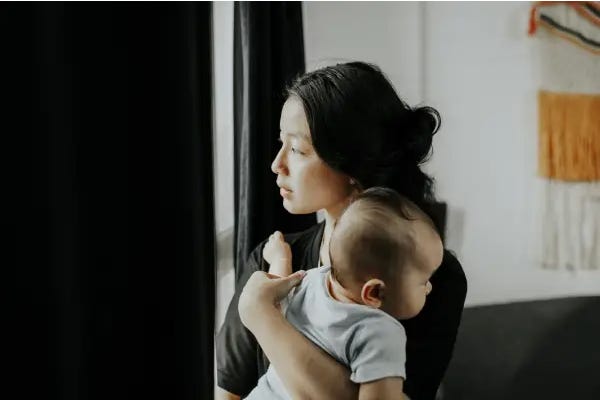
Because culturally, we’re sold the idea that motherhood should feel instinctive, fulfilling, transformative in all the right ways. We’re told that love for our child should eclipse everything else. So when women experience regret, grief, ambivalence, or longing for their old life, it can feel deeply shameful - perhaps especially for women who had a difficult fertility journey, almost unforgivable.
And yet, when we look at the research, maternal regret is far more common than many might think. Studies suggest that in developed countries, around 5 - 15% of parents say that, if they could turn back time, they wouldn’t choose parenthood again. A Facebook group, called “I Regret Having a Child”, has tens of thousands of anonymous members, where parents speak openly about:
exhaustion
financial pressure
loss of support
anxiety
loss of self
and the crushing feeling that nothing they do is ever enough.
I think it’s really important to say this clearly: regret isn’t binary.
A mother can adore her child, be deeply devoted to them, and still struggle with the lived realities and conditions of motherhood.
That doesn’t make her neglectful, uncaring, or abusive.
In fact, sociologist Orna Donath’s work found that the focus of many mothers’ regret wasn’t their child themselves, but the role and conditions of motherhood.
At the same time, I think it’s important to acknowledge that some children require extraordinary levels of caregiving - whether because of additional needs, illness, neurodivergence, trauma, sleep difficulties, or simply the intensity of certain developmental stages. Some seasons of mothering feel genuinely relentless.
That doesn’t mean a mother doesn’t love her child fiercely. It means she’s human, often trying to cope with enormous demands with far too little support around her.
Underneath regret, there’s often grief.
Grief for the gap between the mother you imagined you’d be, and the lived reality of mothering.
Grief for your pre-baby self and life - the spontaneity, freedom, identity, or sense of capability that can feel challenged through matrescence.
And sometimes grief linked to unresolved childhood experiences or fears around repeating painful intergenerational patterns.
I actually think it can be really helpful to think about maternal regret similarly to maternal anger. Both are difficult emotions women are taught to suppress or feel ashamed of - but both contain important information.
So rather than seeing regret as evidence of failure, I think it can help to get curious about it.
Where is it coming from?
What context is it arising within?
What unmet needs might be sitting beneath it?
Because often regret can signal overwhelm - carrying too much, for too long, under impossible expectations. It can be tied to feeling trapped or powerless - in motherhood itself, within a couple relationship, or in life more broadly.
And when women don’t have space to process those feelings, they often leak out sideways - as irritability, resentment, numbness, or anger. Sometimes the rage or regret may not truly be about the child at all, but about loneliness, inequality, lack of support, or relationship dynamics that feel deeply imbalanced. Yet those feelings can end up being projected onto the child because they feel easier - or perhaps more within our control - to locate there.
Reclaiming our agency
I also think there’s something important about agency here.
For some women, particularly where regret feels more enduring, it can be helpful to gently explore the choices that led them into motherhood.
How much did the decision feel genuinely aligned with their own desires and values?
How much was shaped by cultural or familial pressure - the idea that motherhood is simply the expected ‘entry into womanhood’?
Or pressure from a partner wanting a baby, or another child?
Sometimes women realise they never fully experienced motherhood as a wholly conscious choice at all. This can understandably give rise to feelings of resentment or powerlessness.

Returning to what we can control
I find the systemic idea of the ‘circle of concern’ versus the ‘circle of control’ really helpful here.
Many mothers today carry huge fears and concerns about the world their children are growing up in - climate anxiety, finances, safety, education, mental health, online risks, war, inequality. The circle of concern can become enormous.
And while our minds can very easily get trapped there, I often find it grounding to gently come back to the much smaller circle of control, and ask:
What support can I ask for?
What boundary needs setting?
What relationships genuinely nourish me?
What do I need more of outside motherhood?
Because while regret is painful, it doesn’t necessarily mean someone is a bad mother.
Sometimes, far from it.
Regret can become a very human response to carrying too much, for too long, without enough support, space, agency, or understanding.
With love,
Caroline x
How can I support you?
If this piece resonated, my self-paced course Maternal Rage: Changing the Dance of Anger with Loved Ones may support you.
Just like regret, maternal anger is another taboo emotion - one mothers are often taught to suppress, fear, or feel ashamed of. But beneath anger there’s usually important information: overwhelm, unmet needs, old wounds, exhaustion, loneliness, or impossible expectations.
In this course, I help mothers understand their triggers with more compassion, expand their nervous system toolkit, and begin responding in ways that feel more aligned with the mother they want to be - rather than parenting from fear, shame, or survival mode alone.
I’m currently offering £100 off the usual cost - use the code SPRINGSALE to claim your discount. My Spring Sale ends Sunday evening.
Rachael, who recently completed my course, said: “This course was absolutely excellent - I feel I’ve benefited from it hugely. I’m using it every day and teaching my daughter skills from it too.”
2. For an overview of my work, including accessing 1:1 therapy or ordering my book, click here.